Monday, 30 April 2012

Arundel Stresses


I was in Chichester Cathedral yesterday and I saw the Arundel Tomb, the one Philip Larkin wrote a poem about. It was rather a shock to see the actual thing that I had read about so many years before, and it is as beautiful as you might expect. Here's a photo.

The poem (in case you don't know it) is about the fact that the couple depicted in stone effigy are holding hands, and have been holding hands for hundreds of years, quite oblivious to all the passers by. The last line of the poem is:

What will survive of us is love.

And the odd, and brilliant, thing about the line is that you can stress it three ways. By that I'm not talking about the scansion, which is just an iambic tetrameter. I'm talking about... well:

What will survive of us is love.

Would mean that Larkin was talking to one particular woman about his and her mortality.

What will survive of us is love.

Would mean that love was, as it were, the immortal soul of all humans.

What will survive of us is love.

Is far gloomier as it implies the body falling to pieces or becoming the breakfast of worms, whilst only love manages, just, to remain.

Or maybe I'm pushing this too far. Anyway, it's an interesting counterpoint to the much less quoted last stanza of They fuck you up, your mum and dad.

Man hands on misery to man.
   It deepens like a coastal shelf.
Get out as early as you can,
   And don't have any kids yourself. 

I remember my tutor at university saying that that was the bleakest quatrain ever written, as it talked not of private or individual grief, but of the ending of the human race.

File:Philip Larkin in a library.gif
Not that jolly

P.S. According to the cathedral the hand-holding is not a later addition.

Friday, 27 April 2012

To Maffick


On the seventeenth of May 1900 the Siege of Mafeking was relieved. After 217 days of attack from the Boers the British re-enforcements arrived and, when the news got back to Britain, there were wild celebrations. The Boer War had been going badly and any good news was a good excuse to party riotously, or, to use the contemporary term, to maffick.

Mafeking is not, of course, a participle. In fact, it's from the Tswana meaning place of rocks. But that didn't stop people treating it as though it were one. So just as sideling became sidle, so Mafeking became maffick, meaning to celebrate uproariously.

Incidentally, the commander of the British forces at Mafeking was one Robert Baden-Powell, who then founded the scout movement, and wrote a book called Scouting For Boys, which is, apparently, the fourth best selling book of the twentieth century.

Anyway, the weekend is here, so have a good maffick.

Wednesday, 25 April 2012

Make No Bones


To make no bones about something is a rather odd phrase when you think about it, especially as even modern medical science is unable (to my limited modern medical knowledge) to make bones at all.

The origin of the phrase lies hidden in food and drink and soup (the latter a curious platypus between the two). There's an early sixteenth century poem about a pub in Leatherhead and the quality of the beer there. It had a rather unhygienic landlady:

And sometimes she blens
The dung of her hens
And the ale together...

I've drunk at a pub in Leatherhead, and this makes me wary. However, the landlady is sure that it only affects the new ale. So when, later in a the poem, a girl called Ales (Alice) enters the bar,

And as she was drinking
She fell in a winking [doze]
With a barley-hood [booze-induced stupor]
She pissed where she stood
Then began she to weep
And forthwith fell on sleep
Elynour [the landlady] took her up
And blessed her with a cup
Of new ale in corns
Ales found there in no thorns
But supped it at ones
She found therein no bones.

Because it is only bones that make you choke and spit something back up. A few years later a paraphrase of the New Testament has this phrase about Abraham*:

He made no manier bones ne stickyng, but went in hande to offer up his only son Isaac.

And so on and so forth. Until the seventeenth century a lot of the citations keep something of the food metaphor, but it slowly got lost and the bones that were obvious obstacles to digestion simply became mysterious obstacles that were somehow made.

And pubs in Leatherhead? I couldn't tell you whether they've changed. I was in a barley-hood at the time.

The Inky Fool's horse was looking rather thin.

*Yes, I know, but I can't find a copy of the original to explain.

Monday, 23 April 2012

Shakespeare's Birthday

Why bother reading when you have Youtube? Here is me discussing Shakespeare's birthday.


Friday, 20 April 2012

The Macaroni Illusion


I saw a macaronic film last night, which of course relates directly to macaroni cheese, Yankee Doodle's befeathered hat, and a penguin.

The film was La Grande Illusion, which is about French prisoners in Germany in WWI. It therefore shifts between French and German, and, interestingly, when aristocrats wish to talk to each other without the rabble understanding what they're saying, they shift into English. This mixing of languages is called macaronic, because the languages are beaten together in the same way that flour and other ingredients are beaten together to make the great Italian dish macaroni.

So great was the Italian dish of macaroni, that rich C18th travellers would come back to England raving about how delicious macaroni was. They even founded a club called the Macaroni Club at which they could meet, eat macaroni, and discuss how rich and stylish and well-travelled and too-good-for-England they were.

Or maybe they didn't. Though Horatio Walpole did mention in a letter of 1764:

The Maccaroni Club (which is composed of all the travelled young men who wear long curls and spying-glasses).

It's quite possible that he was making the club up, in the way I could dismissively say that people were all members of The Coke and Cocktails Club as a sort of joke.

Anyway, the term caught on and soon any young fop who tried to affect foreign fashions was called a macaroni, which is why when the foolish Yankee Doodle puts a feather in his cap, he called it macaroni.

And finally, there's the question of what you call a foppish penguin. You see, there's a species of penguin that looks as though it spends all its time dying and styling its hair into the most ridiculous fashions, just like a macaronic fop. The species is therefore called the Macaroni Penguin.


So stylish.

Wednesday, 18 April 2012

Smoking a Cicada


I was rather astonished to discover that a cigar is, probably, so called because it resembles a cicada. So saith the OED anyhow. You see, the Spanish for cicada is cigarra and cicadas are said to have bodies that resemble a cigar in shape.

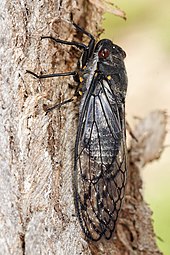
Not being terribly familiar with cicadas (they rarely trouble the sodden residents of Clerkenwell), I had to look them up on Google and... well... have a look at that picture on the right. I can't imagine smoking such a thing by mistake.

But then, then I saw a picture of a cicada cocoon. And suddenly it all made sense. Rather strangely (to my tongue at least), cicadas are often cooked in their cocoons and eaten. Here is a picture:

It's those ones in the middle. Time for lunch, I think.

And, of course, just as a kitchenette is a little kitchen and a maisonette is a little maison, a cigarette is just a little cigar with the stress moved to the first syllable.

Monday, 16 April 2012

Gone Gay


I was watching Bringing Up Baby on Friday night. It's a classic Cary Grant film from 1939, and it reminded me of the word gay.

Nobody is quite sure when gay shifted meaning from jolly to homosexual. It's complicated by the fact that gay could also mean libidinous, as evidenced by a 1939 citation from the OED:

She understood that there had been ‘ladies’. Her father had in fact a‥reputation as ‘gay’.

Which looks a trifle strange to modern eyes. Also, the whole reason that the word gay came to mean homosexual was that it could mean jolly. Here is an explanation of its origins from 1941 by a man named Painter:

Supposing one met a stranger on a train from Boston to New York and wanted to find out whether he was ‘wise’ or even homosexual. One might ask: ‘Are there any gay spots in Boston?’ And by a slight accent put on the word ‘gay’ the stranger, if wise, would understand that homosexual resorts were meant.

And 1941 is the first year that there are unambiguous records of the word in its Uranian sense. However, there are lots of previous citations where gay could just possibly maybe refer to manly love and one of the ones cited in the OED is the film Bringing Up Baby. There's a point where Cary Grant has his clothes stolen whilst he's in the shower and is therefore forced to wander around in a lady's negligée. It's utterly uncertain what the word means here, especially as "go gay" could mean "lose your mind", so judge for yourself.


Whilst this is playing, try pressing 9 on your keyboard again and again and again and again.