Showing posts with label Cinema. Show all posts

Monday, 16 April 2012

Gone Gay


I was watching Bringing Up Baby on Friday night. It's a classic Cary Grant film from 1939, and it reminded me of the word gay.

Nobody is quite sure when gay shifted meaning from jolly to homosexual. It's complicated by the fact that gay could also mean libidinous, as evidenced by a 1939 citation from the OED:

She understood that there had been ‘ladies’. Her father had in fact a‥reputation as ‘gay’.

Which looks a trifle strange to modern eyes. Also, the whole reason that the word gay came to mean homosexual was that it could mean jolly. Here is an explanation of its origins from 1941 by a man named Painter:

Supposing one met a stranger on a train from Boston to New York and wanted to find out whether he was ‘wise’ or even homosexual. One might ask: ‘Are there any gay spots in Boston?’ And by a slight accent put on the word ‘gay’ the stranger, if wise, would understand that homosexual resorts were meant.

And 1941 is the first year that there are unambiguous records of the word in its Uranian sense. However, there are lots of previous citations where gay could just possibly maybe refer to manly love and one of the ones cited in the OED is the film Bringing Up Baby. There's a point where Cary Grant has his clothes stolen whilst he's in the shower and is therefore forced to wander around in a lady's negligée. It's utterly uncertain what the word means here, especially as "go gay" could mean "lose your mind", so judge for yourself.


Whilst this is playing, try pressing 9 on your keyboard again and again and again and again.

Wednesday, 13 October 2010

High


It is a strange and mooreeffocish thing to look upon the photograph of a dear, bald friend in the days when he had hair. Stranger still to think that once upon a time you could be in a dudgeon without that dudgeon being high. Yet so it was, dear reader. In the sixteenth century you could simply take something in dudgeon, the altitude unmentioned.

As for jinks, well they were high before they were anything else. Originally, a highjinks was someone with a good liver and a bad conscience. The highjinks would settle down to booze with a stranger, match him drink for drink, and, when his victim passed out, would rob him (or swindle him while he was semi-conscious).

High could also mean complete or advanced and thus we have high noon and High Noon, which is the most watched film aboard Air Force One.

Now it's high time this post finished. So I shall hightail it (like a stampeding cow) to the high seas (which are high because they're deep).

The Inky Fool kills a man with passive smoke

Saturday, 14 August 2010

Auden and Schwarzenegger: The Hunter Becomes the Hunted!


A plunderer is somebody who takes plunder. Words are often their own victims, and perforce prey on themselves like monsters of the deep. Once such word is prey.

Once upon a toga-clad time, you prehended things, meaning that you got them: hence apprehend, comprehend and reprehensible. Pr(a)ehend then turned into Latin praeda, meaning something that was got, usually plunder. From praeda, via French, we got prey.

From praeda too, the Romans got praedari, meaning to plunder, and from that the English got predation, and from that you got predatory and then finally, in 1908*, you got predator.

And thus the hunter is, etymologically, also the hunted. And thus we are off to the jungles of South America and a crack team of special forces running for their lives and pondering their political careers (two of the actors later became state governors and a third ran unsuccessfully for the governorship of Kentucky).

Anyway, watching Predator I am always reminded of Auden's revisions of his own poetry. It's hard to say what the greatest line in the film is, but one of them is:

There's something out there waiting for us, and it ain't no man. We're all going to die.

Auden once wrote a poem called September 1st 1939 (scholars aren't sure when). It climaxes with this stanza:


All I have is a voice
To undo the folded lie,
The romantic lie in the brain
Of the sensual man-in-the-street 
And the lie of Authority
Whose buildings grope the sky: 
There is no such thing as the State 
And no one exists alone;
Hunger allows no choice
To the citizen or the police;
We must love one another or die.


He then decided that that last line didn't work. We die anyway, whether we love or not. All men are mortal (and most women). So he changed it to "We must love one another and die." But that hardly means anything. You might as well say "We must remember to feed the cat and die". He therefore decided to scrap the whole poem. He suppressed it. It is therefore still omitted from many, many editions of Auden's complete poetry, much to the bewilderment of readers.

The same, of course, applies to "There's something out there waiting for us, and it ain't no man. We're all going to die." Well, of course you're all going to die: all that lives must die, passing through nature to eternity.

That, I think, concludes our week of eighties action movies. I simply can't work out why Rambo is named after a French poet and it's not that interesting that commando was first used in English by Winston Churchill. The old action stars are gone. The golden age has turned to bronze. The stars have gone out one by one (or been cast in The Expendables) and now, as Auden said of Arnold in the same poem:

...helpless governors wake
To resume their compulsory game: 
Who can release them now,
Who can reach the dead,
Who can speak for the dumb?


Whatever is out there, it killed Hopper, and now it wants us.


*There is a lone citation from 1581, but it seems to have been a Latin pun and didn't catch on.

Friday, 13 August 2010

Yippee-Ki-Yay, Oedipus


As an Englishman I never understood the word Yippee-ki-yay, as in 'Yippee-ki-yay, motherfucker'. As Quentin Tarantino so wistfully put it, "I thought it was just a coldblooded thing to say to a motherfucker before you popped a cap in his ass. But I saw some shit this mornin' made me think twice."

Or, more precisely, I saw two things that made me think once.


The first is the Singing Cowboy, Roy Rogers, performing the classic song I'm An Old Cow Hand. (I'm afraid there's an advertisement at the beginning but it's very short).


The second is the original scene from the original Die Hard movie, from which yippee-ki-yay emerged. YouTube only has the audio, but that, gentle motherfucking reader, is all you need. Hans Gruber and John McClane are chatting away to each other on their walkie-talkies.


The line was repeated in the following movies (2: good, 3: terrible, 4.0: don't you understand decimal bloody places?) but in those later attempts to use the same shit twice, the meaning is, tragically, lost.

Thursday, 12 August 2010

Robocop: The Feudal Getter


Once upon a time in central Europe there were lords and peasants. The lords owned all the land but peasants were granted portions of it for themselves. The peasant would then work his own little plot and the lord's. The bigger the peasant's plot, the longer he had to work the fields of the lord who had granted it to him.

This system, abolished by Emperor Josef II (right) in 1848, was called robot.

The system was abolished, but the word of course survived. 72 years later, in 1920, a Czech fellow called Karel Čapek was writing a play. It was about a factory that would produced willing servants out of biological matter. Mr Čapek decided to use the Latin root labor (that gives us labour) and call these servants labori.


And that would have been that were it not for his brother Josef, who suggested calling them robots instead. The play was performed under the title RUR: Rossum's Universal Robots and the word arrived in English two years later.

Meanwhile, cop can mean get, as in the (chiefly British) slang cop out and cop a feel. So policeman, whose job it was to get robbers were called coppers, which was then shortened to cops.

And so by 1987 the touching tale of a factory-produced servile-policeman could comprehensibly be called Robocop.

Now if you'll excuse me, I have to go. Somewhere there is a crime happening.

Original robots in a production of Rossum's Universal Robots

Wednesday, 11 August 2010

Conan the Talkative Barbarian


A little lesson on film dialogue.

The tagline to Conan the Barbarian was: He conquered an empire with his sword. She conquered HIM with her bare hands!

Central to the film is the touching and tender romance between Conan and Valeria. However, in the two-hour movie Conan says only five words to the object of his affection, and they're all within thirty seconds of their first meeting.

'You're not a guard.'


'No.'

True love, eh? But it does show the value of brevity. A screenwriter friend of mine once explained that film is a basically visual medium. You should be able to watch a good movie with the sound turned off. I have experimented with this theory and it's thoroughly true. Even a verbose movie like Pulp Fiction is utterly comprehensible without the words. There are two gangsters in a car. They get out. They go to a flat with some teenagers in. They search it. They find a briefcase. They shoot the teenagers.

Because the storytelling is entrusted to the pictures, the dialogue is free to range through such topics as European hamburger restaurants, foot massages and the Bible. In Conan the Barbarian the dialogue is free not to exist at all.

Incidentally, the taciturn script was the work of the young Oliver Stone.

Yak, yak, yak, yak, yak.

Tuesday, 10 August 2010

Terminator


The terminator is the line that divides the sunlit and night-darkened parts of a planet. That was the original (1770) meaning and it's still used today.

That's because the Latin terminus meant boundary or limit, from which we get bus terminals, terms and conditions, fixed term parliaments and indeed many terms for things (because a term has a limited meaning).

As Tennyson put it:

Be near me when I fade away,
To point the term of human strife,
And on the low dark verge of life,
The twilight of eternal day.

Anyway, from that you get the idea of terminating somebody's employment. Legally speaking, you can do this two ways: you can terminate without prejudice, meaning that you are open to the idea of re-employing them, or you can terminate with prejudice meaning that you will never hire them again. The latter is for employees who have done something awfully naughty and broken your trust.

The CIA employs agents. If you break the CIA's trust and reveal secrets to the other side, your employment will be terminated. Indeed, it will be terminated with prejudice. Indeed, the CIA may make sure that nobody ever employs you again by the simple expedient of murdering you. This they jokingly refer to as termination with extreme prejudice.

The CIA being awfully secret, it's hard to say exactly when the phrase was invented. It's first recorded of a double agent in 1969. The important thing for us, dear reader, is that it is this usage that took the word terminate away from astronomy, contract law and bus depots and made the word big and tough and scary.

And thus and therefore the T800.

As an interesting point of technique: James Cameron just wanted to have a scene where a lorry explodes and then a robot walks out of the burning wreckage. The rest of the plot was invented to lead up to that one image. So the film was written from the end backwards. Compare Mickey Spillane's system explained here.

The Inky Fool's plans for world domination gather pace

Monday, 9 August 2010

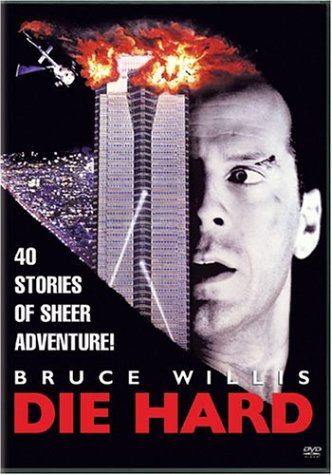
Die Hard 57


This week's posts will be devoted to nineteen-eighties action movies. It is a sad fact, but true, that a small minority of people can watch Arnold Schwarzenegger (or whoever it happens to be) shooting somebody in the face with a big gun without appreciating the underlying philological complexities.

Once upon a time, in 1702, a chap called William Coward wrote a book called Second Thoughts about the nature of the soul. The point at issue was the soul in Hell. If Hell is purely physical suffering (flames, pitchforks up your bottom etc) then how does a metaphysical soul suffer? Moreover, what about people who can take physical suffering? What about people who laugh at pain? Presumably, they'll be tough enough not to mind Hell.

Thus we see by common Observation in Men condemned to die ignominiously at the Gallows, with what Impudence, and strange effrontery they bear their Sufferings; nay, even when they ought to have a check and remorse of Conscience for fear of an immediate Judgement or punishment for their Sins by God Almighty

John Broughton, chaplain to the Duke of Marlborough, read Second Thoughts and didn't like it one bit. He got so angry that he wrote a point-by-point rebuttal, which he published under the catchy title Psychologia or An Account of the Nature of the Rational Soul. Broughton mentioned that passage from Second Thoughts and summed it up thusly:

...he urges the Case of those that die hard, as they call it, at Tyburn...

And that is the first die hard ever recorded. It should be noted that hard here means tough or stubborn. The condemned man does not struggle or try to live. He is, instead, impudent and shows no fear.

The phrase would have stuck around in the obscurity of the gallows were it not for another fellow called William Inglis exactly a century later. Inglis was fighting the French at the Battle of Albuera, when he was hit by a four pound piece of grapeshot, which went through his neck and shoulder and lodged in his upper back.

Minor injuries like this, though, could not shut Inglis up, nor did the fact that the 57th Foot Regiment, which he was commanding, was being slaughtered seem to bother him. Instead he sat amongst his beleaguered men shouting again and again: "Die hard, 57th, die hard."

Astonishingly, Inglis survived and the 57th won the battle. Inglis became a hero, his exploits became famous, and the 57th Foot Regiment were nicknamed the Die-Hards.

Thus the phrase became famous and was taken up by all and sundry, especially conservative political factions who used it as an adjective. Those Tories who opposed Home Rule at the beginning of the twentieth century were die-hard conservatives. All it then required was for Alan Rickman to put on a funny accent and the rest is cinematic and linguistic history.

I don't know where Bruce Willis stands on the nature of the human soul. I should like to know what he thinks, but Mr Willis maintains a sphinx-like silence on the matter.

40 STORIES OF SHEER PHILOLOGY!

Thursday, 3 June 2010

Hangover Square


I am as hungover as an avenue of willow trees. So all you're getting today are three descriptions of wages of gin. This from Lucky Jim:

Dixon was alive again. Consciousness was upon him before he could get out of the way; not for him the slow, gracious wandering from the halls of sleep, but a summary, forcible ejection. He lay sprawled, too wicked to move, spewed up like a broken spider-crab on the tarry shingle of the morning. The light did him harm, but not as much as looking at things did; he resolved, having done it once, never to move his eyeballs again. A dusty thudding in his head made the scene before him beat like a pulse. His mouth had been used as a latrine by some small creature of the night, and then as its mausoleum. During the night, too, he'd somehow been on a cross-country run and then been expertly beaten up by the secret police. He felt bad.

This from the Second Canto of Don Juan by Byron:

Few things surpass old wine; and they may preach
Who please - the more because they preach in vain -
Let us have wine and women, mirth and laughter,
Sermons and soda-water the day after.

(Although it wasn't old wine that did for me, but a pantagruelian dry martini that ambushed me at midnight near Hyde Park Corner.) And here is the original screenplay of Withnail & I.

WITHNAIL emits an accelerating groan. Something to do with a headache. He looks across. Eyes like a pair of decayed clams.

WITHNAIL: Where's the whisky?

MARWOOD: What for?

WITHNAIL: I got a bastard behind the eyes. I can't take aspirins without a drink...
The bottle is discovered. The cork popped. And back to MARWOOD.
Where's the aspirins?

MARWOOD: Probably in the bathroom.

WITHNAIL: You mean we've come out here in the middle of fucking nowhere without aspirins?

This appears to be the case. WITHNAIL is becoming emotional.

MARWOOD: Where are we?

WITHNAIL: How should I know where we are? I feel like a pig shat in my head.

And for those of you who are fond of Withnail, here is a piece of trivia that not even Paul McGann knew until I told him in a moment of drunken sincerity. The character referred to as Marwood in the script is never named in the film, hence the title. However, when I finally saw Withnail & I in a cinema I noticed the name written on the envelope containing the telegram. You can't see it on a television because (like an unfinished whodunit or invader of Iraq) it doesn't have the resolution. So Marwood is named, and the film's title must and shall be changed.

From Hell's black heart I curse thee