Showing posts with label semantic shifts. Show all posts

Wednesday, 21 March 2012

Manufactured Manure


It's always rather pleasant to watch a word shift in meanings until it means the opposite of itself. Such a word is manufactured, which is Latin for handmade. Manus is hand, as in manual, and facture is making as in, well, a factory, where things are made. But the difference between a factory and a manufactory is the handiwork.

Thus an Elizabethan chap could write:

Yet the image is rather a manufacture, to wit, a thing wrought vpon a creature by the artificer's hand...

And yet now, we would consider handmade and manufactured to be antonyms.

Another lost hand of etymology is manure. Once upon a time manuring was simply working by hand. People would manure their farms and gardens until their hands were sore. But obviously, a central part of this horticultural handiwork, was spreading dung upon the land. Mind you, a 1561 translation of Calvin could still have the line:

The worde of God‥if it light upon a soul manured with the hand of the heavenly spirit, it will bee most fruitfull.

Which is something to consider next time you're getting a manicure.


Wednesday, 24 August 2011

Pot Shots


I was watching the telly yesterday and there was a man in a blue flak jacket talking about snipers taking pot shots. He was concerned about this because he might be killed; I was concerned because I didn't know why pot shots were called that. I suspected that it had something to do with snooker. How wrong I was.

The term goes back to hunting. There are two kinds of hunter: the sportsman who kills merely for the pleasure of ending another animal's life, and the hungry hunter who kills things for the thoroughly base reason that he wants to put them in his cooking pot and eat them. In the eighteenth century this latter was called a pot hunter.

As somebody anonymous put it in an 1825 tract on bull baiting:

There's nothing a regular Shot would be sooner chafed at than being called a Pot-hunter.

What makes pot hunters so despicable is that they kill things at the wrong time of year. They are so hungry that they can't even wait for the glorious twelfth until they start shooting. Instead, they potter around firing pot shots at animals that they intend to eat, this new term popped up in 1839.

From there it was a trifling step to start using the term for any opportunistic bit of gunfire, and then to capricious insult or heckle. And that's how you get to the snipers of Tripoli taking pot shots, presumably with the intention of cannibalism.


Monday, 18 July 2011

Qualm


Somebody mentioned having "no qualms" about something on Saturday night, and it made me wonder what a qualm actually was. A quick check in the dictionary told me that a qualm could be the cry of a raven. But the qualm of conscience turned out to be one of those weakening words, like naughty.

Back in Old English qualm meant violent death, pestilence and plague. In fact, a qualm was anything that was monstrously and bloodily horrific. A qualm-house was a torture chamber, a qualm-stow was a place of execution.

Then, in the sixteenth century, it started to mean a period of suffering, like a bout of fever. Then it began to mean a brief illness, and then a faint feeling of discomfort. And it's from that last meaning that we get the modern ever-so-delicate qualm of conscience.

This means, that you can have no qualms about committing qualms.

Now, I'm off to a qualm-house to feel qualmish.

Many qualms and none

Wednesday, 6 July 2011

Match-Makers


The New Dictionary of the Terms Ancient and Modern of the Canting Crew in its several Tribes of Gypsies, Beggers, Thieves, Cheats &c. (1699) has this odd little entry:

Match-makers, a better sort of Procuruers of Wives for Men, or Husbands for Women, Maiden-head-Jobbers, Virginity Sellers, Brokers, &c.

It wasn't until the nineteenth century that we got the weakened sense of somebody who tries to encourage to friends to get friendly. I suspect that the same shift is currently happening with the word pimp. People are always talking about pimping in the weak sense of trying to sell or to get employment, or at least they are round my way. Perhaps, in a hundred years time, recruitment agencies will simply call themselves pimps and only those with historically based dictionaries will know what the word once meant.

Incidentally, the town of Maidenhead in Buckinghamshire is the landing place of the maidens, and has nothing to do with virginity; but Omagh (as in the bombing) does, it means virgin plain. Which is all the excuse I need to post this:

Tuesday, 10 May 2011

Editor


Editor was once a Latin word meaning one who puts forth. That's why the chap or chappess who puts forth a book came to be known as an editor. As the putter-forth of a book usually has to make some alterations we then got our familiar verb edit. As those alterations are usually deletions, edited has come to mean cut.

However, it's worthwhile remembering that editor only got attached to books by coincidence. Etymologically, somebody who threw you out of a nightclub or a window could have been called an editor. Moreover, the original Roman editors were much more brutal people.

In the high and palmy state of Rome the Editor was the man who put out the games at the Colosseum. He obtained the Christians, the lions, the gladiators and decided, in his pomp, which would live and which die. A couple of descriptions will help:

The editor giving the games, usually to curry political favor with the mob, rode behind on a chariot perhaps drawn by exotic wild animals such as zebras or even ostriches.

And:


If the emperor was not in attendance, the producer (editor) of the games decided the fate of the victim. Even if defeated, a gladiator might be granted a reprieve (missus) if he fought well or, if neither fighter prevailed, both could be reprieved stans missus. But a gladiator also could be forced to fight again the same day, although that was considered bad form, and there were contests in which no reprieve was granted the loser (sine missione).

Ask any writer: nothing has changed.

The Inky Fool asks whether something should be cut

Monday, 9 May 2011

The Return of the Mission


I met a distressed vicar yesterday. The source of his troubles was not guilt or doubt or the approach of the rapture: the terror facing this particular vicar was that this week he has to write a Mission Action Plan.

The management jargon shuddered on the preacher's lips like a blasphemy. He had to write down goals and objectives and mission statements and feed forward his blue-sky ideas from outside the box. That's what a Mission Action Plan (or MAP!) is.

He asked me whether I would write it for him, assuring me that it would be a work of pure fiction anyway. I refused because I am lazy. But as I wandered away from God and towards the pub, it occurred to me that the word mission has come full circle. The primary meaning of mission, as defined in the OED, is:

In Trinitarian theology: the sending into the world of the Son or Spirit by the Father, or of the Spirit by the Son, esp. for the purpose of salvation.

This is the sense that the word had in 1530. Mission was a solely religious word for the first hundred years of its existence in English. It's from the Latin misso, meaning send, and is, or was, the exclusive preserve of missionaries. It wasn't until 1626 that Francis Bacon invented the idea of godless, diplomatic mission, and it wasn't until 1910 that anybody had the idea that soldiers might be sent on a mission. The missions impossible and accomplished of soldiers and spies are a twentieth century invention.

And shooting people, as everybody knows, is cool and efficient. So it's the military sense of mission that was eventually stolen by business-speak and by management consultants. The modern Director of Regional Sales no longer has a job, he has a mission, just like a soldier, a mission that he must complete at all costs (or, preferably, minimum cost).

And guess who appropriated the word mission from the horrid world of management jargon and gibberish? That's right. The Church of England.

So mission has come full circle: from theology to diplomacy, to the military, to management-speak and back at last to its true home in the church. It is the prodigal son of the language, sleeping among the swine.

Indeed, I think the story of mission has already been described in the Ecclesiastes:

The thing that hath been, it is that which shall be; and that which is done is that which shall be done: and there is no new thing under the sun. Is there any thing whereof it may be said, See, this is new? it hath been already of old time, which was before us.

And that is, of course, the origin of the phrase nothing new under the sun.

I cannot believe that this graph exists


P.S. Yes. There will be a post on the missionary position some time later in the week. I may have to do some research in the British Library.

Wednesday, 20 April 2011

National Gaiety


Thou seyst also, that if we make us gay...
That it is peril of oure chastitee

Said Chaucer six hundred and something years ago.

Aunt: Why are you wearing these clothes?
David: Because I just went gay, all of a sudden.

Thus the film Bringing Up Baby in 1938.

And then, quite suddenly, the word gay leapt out of the closet singing a showtune. This shift is usually dated to the beginning of the 1940s. But gay left its brothers behind. This from yesterday's Evening Standard describing some forthcoming nuptials:

...the gaiety and chutzpah will tend to be on the Middleton side.

Will it? My word! Who would have thought that our future queen was that way inclined? And the England manager too? Impossible! Not according to Sky Sports:

All hail Mr Capello then for a week in which he's been upsetting all and sundry with the gay abandon we've secretly grown to admire

Well, I'd say I'll be blowed but you might misunderstand my relationship with both Mr Capello and the Middletons. Blowed, not blown. What's peculiar here is that while the adjective gay shifted suddenly and irrevocably in meaning, the noun gaiety stayed exactly where it was, unaffected by the explosion. Nobody talks about Elton John's gaiety, and if they did we would assume that the chap was happy. Gay abandon can survive in football, of all sweaty and uncouth places, without anybody batting an eyelid. But gay? Gay is gay and bound to stay that way.

Strange how two forms of one word can split like that, but I suppose it all adds to the homosexuality of nations.

Angry gaiety

Sunday, 10 April 2011

Bonny and Buxom


One final post on weddings. In Medieval wedding services the wife would promise the following:

I take thee, John, to be my wedded husband, to have and to hold, from this day forward, for better for worse, for richer and poorer, in sickness and health, to be bonny and buxom, in bed and at board, till death do us part, and thereto I plight thee my troth.

Now, this seems to our modern eyes to be a strange sort of promise. How could a wife guarantee that she would be buxom? Were thin women unable to marry in church? However, the word buxom has changed in meaning over the years. The first citation of buxom in the OED comes from the twelfth century and is defined as: Obedient; pliant; compliant, tractable. The sense then changed to happy, then to healthy, and thence to plump.

Meanwhile bonny comes from the French bon and the Latin bonus, both of which mean good. So a bonny and buxom wife was a good and obedient one, which is why it was eventually replaced by loving, honouring and obeying. There's even a sixteenth century reference to being "bonnaire and buxome to the Pope".

Anyway, this form of the service is still occasionally used. There's a story about it here.

Thursday, 17 March 2011

Nervous Nations


This is from the preface to Nathan Bailey's Universal Etymological Dictionary of 1721:

Some have remark'd that there is a constant Resemblance between the Genius of each People and the Language which they speak, and thence


The French who are a People of great Vivacity have a Language that runs extreme Lively and Brisk, and the Italians who succeeded the Romans have quite lost the Augustness and Nervousness of the Latin and sunk into Softness and Effeminacy, as well in their Language as their Manners.


The Spaniards, whose distinguishing Character is a haughty Air, have a Language resembling their Qualities, yet not without Delicacy and Sweetness.


The Romans who seem'd to be a People design'd for Command, us'd a Language that was noble, august and nervous.


The Greeks who were a polite but voluptuous People, us'd a Language exactly adapted thereto.


The English who are naturally Blunt, thoughtful and of few Words, use a Language that is very short, concise and sententious.

Quite aside from the truth of all this, it's strange to see how the word nervous has changed in meaning. Nerves were once identified with the sinews. So nervous was a synonym for sinewy, and meant tough.

Similarly, sententious was once a word of praise. A sentence used to be an opinion or judgement (which sort of survives, in that a trial ends up with a judge giving a sentence). From that you got the idea that a single opinion could be expressed in a sentence, hence a grammatical sentence. So, if your speech is not vapid and meaningless, if it contains a thought, it is sententious.

T.S. Eliot used the old sense of sentence in The Love Song of J. Alfred Prufrock. It should therefore be stressed on the second syllable.

No! I am not Prince Hamlet, nor was meant to be;
Am an attendant lord, one that will do
To swell a progress, start a scene or two
Advise the prince; no doubt, an easy tool,
Deferential, glad to be of use,
Politic, cautious, and meticulous;
Full of high sentence, but a bit obtuse;
At times, indeed, almost ridiculous—
Almost, at times, the Inky Fool.

It is vital for good English that you keep your sentences short and simple.

Thursday, 3 March 2011

Glory-Hole


I was relieved to read the Brewer's Dictionary of Phrase and Fable definition of Glory-Hole


A small room, cupboard or the like, where all sorts of odds and ends and junk are dumped.

The OED says that a glory hole can also be a sailor's cabin, or a glass-blower's kiln. I really wouldn't check the Urban Dictionary' s definition unless you have a mind inured to all depravity.

This shows approximately the same lewd development as peep show and felch.

Friday, 25 February 2011

Little Banquets


In Italian, the suffix -etto means little. So Giovanni Canal, because he was the son of the painter Bernard Canal, was known as Canaletto. It just means Canal Junior. (Similarly, Alessandro di Mariano di Vanni Filipepi, had an elder brother who was nicknamed The Keg, or Il Bottici. So he, the little brother, was nicknamed The Little Keg, or Botticelli.)

A bench in Italian is a banco. So a little bench was a banchetto, hence the English banquette.

Now, if you're in a terrible hurry and don't have time for a proper lunch, what do you do? You buy a sandwich, you sit on a park bench and you gobble it up into your greedy gob. Thus, a snack, the sort of thing you eat on a little bench, is a banquet.

'Eh?' I hear you cry. 'A banquet isn't a little snack. It's a bloody great feast that goes on for hours and involves quails and fried elephants. It's not something you munch on in a hurry.'

And you're right, dear reader, utterly right. That's what banquet means now, but once it meant a tiny snack, probably eaten between proper meals. And absolutely nobody knows how the word got from the one meaning to the other.

I'm now going to make myself a quick banquet.

A dinner party at Inky Fool mansions

Friday, 28 January 2011

Survival of the Fittest Fiddle


A little note on Darwin. When we think of the adjective fit we are inclined to think of someone in jogging shorts and other such hideousness. Fit to us means physically capable and the fittest person is the fastest runner, or something of the sort. This is not the sense in which Darwin* used the phrase.

We still use phrases like fit and proper parent or fit for purpose or not fit to hold office, and that was the original meaning of the word fit. It meant appropriate. The fittest word, is the word most appropriate to the situation.

As Stephen Jay Gould once remarked, it doesn't matter how wonderfully developed a fish is, if all the oceans dry up it will die. Similarly, Darwin couldn't have cared less whether a Galapagos turtle could run fast, only that it was well suited to its environment.

If the cap fits, it doesn't mean that it's been to gym.

How did the word get from one to the other? On horseback. Or more precisely, via horse racing. If a horse was in fit condition for a race then it was fit in the modern sense.

And fiddles? Nobody is quite sure why fiddles are fit, although it is certain that the older sense was being used. There also used to be a phrase as fine as a farthing fiddle, which makes more sense and is more fun to pronounce.
The Inky Fool contemplating the gym


*The phrase pops up in the fifth edition of On The Origin Of Species, although it was in fact invented by a chap called Herbert Spencer, who was trying to describe the ideas set out in the first edition of On The Origin Of Species. So it's Darwin adopting a paraphrase about Darwin, if you see what I mean.

Sunday, 16 January 2011

Clouds and Skies


It is testament to the wonders of English weather that the word sky, originally meant cloud. On this grey and overcast island there is little or no difference between the two concepts. So the meanings merged.

Sunbathing with the Inky Fool

P.S. If you wanted to know what pie is doing in the sky, see this old post.

Friday, 7 January 2011

Amazing Clues


How vainly men themselves amaze...

Old meanings are confusing enough without shoving two into a line, yet that is what Andrew Marvell did without a flicker of compunction in the opening line of The Garden. The modern reader would be almost excused for thinking that narcissistic men are going about impressing themselves. Though that may be so, Marvell is writing about men who futilely consign themselves to a labyrinth, or maze.

Labyrinths are terrible places, teeming with minotaurs and littered with lost threads, or at least that's how I imagine them. Hampton Court was a disappointment. The reason, of course, is that I was exposed to the myth of Theseus as an infant, though the really dirty bits were thoughtfully concealed from me until I was six.

Anyway, Theseus had to run into the labyrinth, kill the Minotaur and dash out again, all in time for tea. Ariadne, fearing that the tea would go cold, suggested the preposterously obvious idea that he take some thread with him, unwind it on the way in, and follow it on the way out. That way he would not be amazed.

What with the Trojan horse and Ariadne's thread, one can see the Attic genius for the bleeding obvious. To stop himself getting lost he had a thread. And what was the medieval term for a ball of yarn? It was, dear threadbare reader, a clue.

It was a clue that Theseus laid for himself in the labyrinth, it was a clue that led him back and dismazed him. If he had not had a clue of thread he would not have had a clue about how to escape. As John Pomfret wrote of the ideal woman:

She knows the best, and does the best pursue,
And treads the maze of life without a clue,
That the weak only and the wavering lack,
When they're mistaken, to conduct them back.
She does, amidst ten thousand ways, prefer
The right, as if not capable to err.

Slowly, of course, the clue that leads you through the labyrinth became the key that solves the puzzle, and then became the hint that helps you to solve the puzzle, and then, in 1914, received its apotheosis when it was attached to crosswords.

Incidentally, the original labyrinth (etymology uncertain) in which the Minotaur resided was designed by Daedalus, and has therefore been called a Daedal.

Now read this lovely poem by Auden. It's called The Labyrinth.


Anthropos apteros for days
Walked whistling round and round the Maze,
Relying happily upon
His temperament for getting on.


The hundreth time he sighted, though,
A bush he left an hour ago,
He halted where four alleys crossed,
And recognized that he was lost.


"Where am I?" Metaphysics says
No question can be asked unless
It has an answer, so I can
Assume this maze has got a plan.


If theologians are correct,
A Plan implies an Architect:
A God-built maze would be, I'm sure,
The Universe in minature.


Are data from the world of Sense,
In that case, valid evidence?
What in the universe I know
Can give directions how to go?


All Mathematics would suggest
A steady straight line as the best,
But left and right alternately
Is consonant with History.


Aesthetics, though, believes all Art
Intends to gratify the heart:
Rejecting disciplines like these,
Must I, then, go which way I please?


Such reasoning is only true
If we accept the classic view,
Which we have no right to assert,
According to the Introvert.


His absolute pre-supposition
Is - Man creates his own condition:
This maze was not divinely built,
But is secreted by my guilt.


The centre that I cannot find
Is known to my unconscious Mind;
I have no reason to despair
Because I am already there.


My problem is how not to will;
They move most quickly who stand still;
I'm only lost until I see
I'm lost because I want to be.


If this should fail, perhaps I should,
As certain educators would,
Content myself with the conclusion;
In theory there is no solution.


All statements about what I feel,
Like I-am-lost, are quite unreal:
My knowledge ends where it began;
A hedge is taller than a man."


Anthropos apteros, perplexed
To know which turning to take next,
Looked up and wished he were a bird
To whom such doubts must seem absurd.


And buy the Complete Auden here.

The Inky Fool visits Hampton Court

Thursday, 6 January 2011

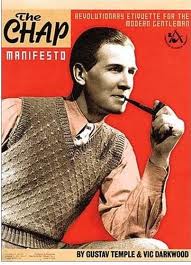
Dear Chap


A dear chap is a bad thing, etymologically speaking.

Once upon a time, markets were called cheaps. That's why there's Cheapside and East Cheap in London. Cheap meant any sort of trade or bargaining or financial push-me-pull-you. If prices were low, it was a good cheap, just as with the French bon marché. If prices were high, it was a dear cheap, as in the Promptorium Parvulorum's:

He byeth in tyme and at hour, so that he hath not of the dere chepe

So a market man, a buyer or a seller, became a chapman. Then chapman dwindled to chap so that in The Beggar's Opera (1728) Peachum can say:

Wife, rip out the Coronets and Marks of these Dozen of Cambric Handkerchiefs, for I can dispose of them this Afternoon to a Chap in the City

By which he does not mean fellow, but customer. However, trade and humanity are woven fine. It is in the nature of Economic Man to view all his fellow fellows through the distorting lens of a shop window. Thus we talk today about a tough customer, even though the tough in question may have no intention of buying.

Similarly, chap drifted from meaning a potential purchaser and, sometime in the Eighteenth Century, became a word for any old fellow. And if you like the chap, he's a dear chap and that's now a Good Thing.

A chapbook was a book sold to a chapman

P.S. Is mine the only dank and disgusting mind to have noticed the possible connotations of chap-stick? 

Tuesday, 4 January 2011

Expressly Expressing Express Espressos


If you have ever expressed yourself on an express train, you may have wondered about the origin of the expression and why it should expressly mean that. You may then have settled down with an espresso and forgotten all about it.

Once upon a terribly long time ago there was a Latin word exprimere, which meant to press out, and the past participle of which was expressus. When you press your seal* into soft wax you produce an image, and, so far as anybody can tell, that's why the Latin word took on the meaning of describing or representing something.

Cows expressed milk, sores expressed pus and human beings were expressed by God. Very quickly people got the idea of expressing thoughts as words, as though the mouth were the udder of the mind. Thus Chaucer's:

Thy virtue and thy great humility
There may no tongue express

Also from this came the idea of something that was specifically, or expressly, designed for one purpose and for no other. If God expressed man, he did it rather well, or at least that's what Hamlet thought:

What a piece of work is a man! how noble in reason! how infinite in faculty! in form and moving how express and admirable! in action how like an angel! in apprehension how like a god!

We still use this meaning when we say expressly. Thus today's Guardian:

In a work expressly intended for students to perform, Pountney has created a dramatic structure that interlocks three stories of 20th-century student political action...

So how do you send a letter? Do you entrust your epistle to the general mail, or do you employ somebody expressly to deliver it? Do you find a chap, give him one letter and express instructions? If so, then you have sent the letter express.

The same sort of thing happened to trains. Some trains dawdle. They may say on the front that they are going to Euston, but once aboard you discover that they are in no great hurry to get there and that you will probably be pausing at Moreton-St-Davids for an hour or so while they load up the baggage car with sheep. What you need is a train that is meant expressly and exclusively for Euston, a train that does not stop anywhere else.

These days express trains aren't very express and will probably terminate at Preston on a whim, but that's not how it once was, dear reader.

And so a word that meant press out came to mean describe and intentional and specific and fast and non-stop.

And espressos? Though an espresso should be drunk quickly and is probably expressive of something or other, the dwarf coffee owes its name to the original Latin. You see, the steam is pressed out through the coffee grains and into the bonsai cup.

Like a cow expressing milk

*By which I mean a coat of arms, not a marine mammal. I made that mistake once and the zookeeper got cross.

Friday, 29 October 2010

Boring Drilling


I have, of late, been mucking around with power tools. Boring is rather boring, and one must learn the drill for drilling.

So far as anybody can tell*, these senses are related. A bore proceeds slowly through the rock: a bore proceeds slowly through his subject. However, it should be noted that there is a French word bourre, which means padding, that may bear responsibility.

Drills, when they're boring, go round and round and round and round; and soldiers when they march around the parade ground do the same. Thus drill to drill. Drill then came to mean anything routine, such as a fire-drill, which is, coincidentally, very boring.

I am now going to listen to The Turn Of The Screw**.

The Inky Fool got carried away


*And nobody is utterly sure.

** There was a young lady from Whitton
Who was kinky for Benjamin Britten;
And the things she would do
To The Turn Of The Screw
Are so lewd they can't even be written.

Wednesday, 13 October 2010

High


It is a strange and mooreeffocish thing to look upon the photograph of a dear, bald friend in the days when he had hair. Stranger still to think that once upon a time you could be in a dudgeon without that dudgeon being high. Yet so it was, dear reader. In the sixteenth century you could simply take something in dudgeon, the altitude unmentioned.

As for jinks, well they were high before they were anything else. Originally, a highjinks was someone with a good liver and a bad conscience. The highjinks would settle down to booze with a stranger, match him drink for drink, and, when his victim passed out, would rob him (or swindle him while he was semi-conscious).

High could also mean complete or advanced and thus we have high noon and High Noon, which is the most watched film aboard Air Force One.

Now it's high time this post finished. So I shall hightail it (like a stampeding cow) to the high seas (which are high because they're deep).

The Inky Fool kills a man with passive smoke

Monday, 4 October 2010

I Shall Demonstrate The Reality Of This Dessert


Words change their meanings: phrases survive. Prove once meant test as well as show to be true. The two meanings are so close that they could reasonably interchange. To be tried and tested is to be shown adequate. Nobody says, though I suppose they could, that he was tried and tested... and found wanting.

Proof as test died out. But the phrase The proof of the pudding is in the eating remains, almost incomprehensible to modern ears: cogito ergo tiramisu. Similarly, the exception is still said to prove the rule, which, with the modern meaning of prove, is a statement of delightful fatuity.

Proving grounds are not, of course, places for ambitious epistemologists, but places where you are tested. And so on and so forth until it all proves too much.

It's enough to drive a proof reader to gin, strong gin, maybe 80% proof, and that's not waterproof.

Bullet-proof


P.S. I'm now suffering from lapse of meaning.

Thursday, 5 August 2010

Playing Little Roll


All the world, as some minor poet once observed, is a stage and all the men and women merely players. To act upon this stage you need, of course, a script, and that script was once given to you not as a book but as a rolled up sheet of parchment. You were given a roll and thus you were given a role.

The shift from concrete noun to abstract happened in Medieval French before the word had even arrived on these chilly shores and the first role-player in English was John the Baptist* who "from God hath receiued such a rowle, it being inioyned him, to prepare the way of the Lord."

This means that the 98,200 references on the Internet to playing little role rather than a little role read rather awkwardly. Role-play has become a zombie metaphor. If we could forget actors, playing little role would seem fine. But as an actor would only play a little role or a little part, the omission of the indefinite article is liable to raise the thoughtful reader's hackles. Indeed, this whole post comes from a question on the Dear Dogberry page.

The problem is, though, that the "a" suggests importance. Compare and, if you must, contrast:

Elephants play little role in British politics


Elephants play a little role in British politics

The first sentence suggests "little or no" and is final. Are elephants irrelevance...s? Yes. The second sentence suggests that pachyderms do something, probably more than you think, and that the writer is now going to explain exactly what small role they play.

So, what to do? Should one stay true to the moribund metaphor or stride callously onwards into the waste land of contemporary usage? I can't say I'm sure. I would only write of playing a little role, and when I want to dismiss something as an irrelevant elephant I shall use another phrase entirely.

While we're on the subject of actors and their parts, I should inform you that winging it has nothing to do with flying, it is rather instead what an actor does when called in to play a role at short notice and is forced to learn his lines in the wings of the theatre. He can only reasonably do this if he has been given a small roll.

Jack Kerouac wrote On The Road on one huge roll of paper.
That is the only interesting thing about the book.


*So far as I can tell.