Thursday, 12 August 2010

Robocop: The Feudal Getter


Once upon a time in central Europe there were lords and peasants. The lords owned all the land but peasants were granted portions of it for themselves. The peasant would then work his own little plot and the lord's. The bigger the peasant's plot, the longer he had to work the fields of the lord who had granted it to him.

This system, abolished by Emperor Josef II (right) in 1848, was called robot.

The system was abolished, but the word of course survived. 72 years later, in 1920, a Czech fellow called Karel Čapek was writing a play. It was about a factory that would produced willing servants out of biological matter. Mr Čapek decided to use the Latin root labor (that gives us labour) and call these servants labori.


And that would have been that were it not for his brother Josef, who suggested calling them robots instead. The play was performed under the title RUR: Rossum's Universal Robots and the word arrived in English two years later.

Meanwhile, cop can mean get, as in the (chiefly British) slang cop out and cop a feel. So policeman, whose job it was to get robbers were called coppers, which was then shortened to cops.

And so by 1987 the touching tale of a factory-produced servile-policeman could comprehensibly be called Robocop.

Now if you'll excuse me, I have to go. Somewhere there is a crime happening.

Original robots in a production of Rossum's Universal Robots

Wednesday, 11 August 2010

Conan the Talkative Barbarian


A little lesson on film dialogue.

The tagline to Conan the Barbarian was: He conquered an empire with his sword. She conquered HIM with her bare hands!

Central to the film is the touching and tender romance between Conan and Valeria. However, in the two-hour movie Conan says only five words to the object of his affection, and they're all within thirty seconds of their first meeting.

'You're not a guard.'


'No.'

True love, eh? But it does show the value of brevity. A screenwriter friend of mine once explained that film is a basically visual medium. You should be able to watch a good movie with the sound turned off. I have experimented with this theory and it's thoroughly true. Even a verbose movie like Pulp Fiction is utterly comprehensible without the words. There are two gangsters in a car. They get out. They go to a flat with some teenagers in. They search it. They find a briefcase. They shoot the teenagers.

Because the storytelling is entrusted to the pictures, the dialogue is free to range through such topics as European hamburger restaurants, foot massages and the Bible. In Conan the Barbarian the dialogue is free not to exist at all.

Incidentally, the taciturn script was the work of the young Oliver Stone.

Yak, yak, yak, yak, yak.

Tuesday, 10 August 2010

Terminator


The terminator is the line that divides the sunlit and night-darkened parts of a planet. That was the original (1770) meaning and it's still used today.

That's because the Latin terminus meant boundary or limit, from which we get bus terminals, terms and conditions, fixed term parliaments and indeed many terms for things (because a term has a limited meaning).

As Tennyson put it:

Be near me when I fade away,
To point the term of human strife,
And on the low dark verge of life,
The twilight of eternal day.

Anyway, from that you get the idea of terminating somebody's employment. Legally speaking, you can do this two ways: you can terminate without prejudice, meaning that you are open to the idea of re-employing them, or you can terminate with prejudice meaning that you will never hire them again. The latter is for employees who have done something awfully naughty and broken your trust.

The CIA employs agents. If you break the CIA's trust and reveal secrets to the other side, your employment will be terminated. Indeed, it will be terminated with prejudice. Indeed, the CIA may make sure that nobody ever employs you again by the simple expedient of murdering you. This they jokingly refer to as termination with extreme prejudice.

The CIA being awfully secret, it's hard to say exactly when the phrase was invented. It's first recorded of a double agent in 1969. The important thing for us, dear reader, is that it is this usage that took the word terminate away from astronomy, contract law and bus depots and made the word big and tough and scary.

And thus and therefore the T800.

As an interesting point of technique: James Cameron just wanted to have a scene where a lorry explodes and then a robot walks out of the burning wreckage. The rest of the plot was invented to lead up to that one image. So the film was written from the end backwards. Compare Mickey Spillane's system explained here.

The Inky Fool's plans for world domination gather pace

Monday, 9 August 2010

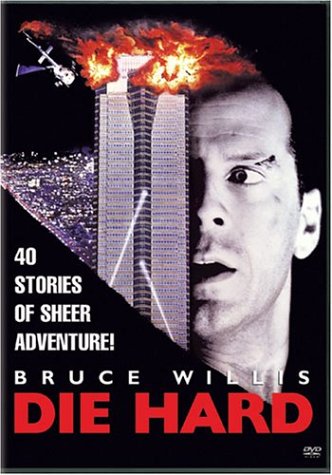
Die Hard 57


This week's posts will be devoted to nineteen-eighties action movies. It is a sad fact, but true, that a small minority of people can watch Arnold Schwarzenegger (or whoever it happens to be) shooting somebody in the face with a big gun without appreciating the underlying philological complexities.

Once upon a time, in 1702, a chap called William Coward wrote a book called Second Thoughts about the nature of the soul. The point at issue was the soul in Hell. If Hell is purely physical suffering (flames, pitchforks up your bottom etc) then how does a metaphysical soul suffer? Moreover, what about people who can take physical suffering? What about people who laugh at pain? Presumably, they'll be tough enough not to mind Hell.

Thus we see by common Observation in Men condemned to die ignominiously at the Gallows, with what Impudence, and strange effrontery they bear their Sufferings; nay, even when they ought to have a check and remorse of Conscience for fear of an immediate Judgement or punishment for their Sins by God Almighty

John Broughton, chaplain to the Duke of Marlborough, read Second Thoughts and didn't like it one bit. He got so angry that he wrote a point-by-point rebuttal, which he published under the catchy title Psychologia or An Account of the Nature of the Rational Soul. Broughton mentioned that passage from Second Thoughts and summed it up thusly:

...he urges the Case of those that die hard, as they call it, at Tyburn...

And that is the first die hard ever recorded. It should be noted that hard here means tough or stubborn. The condemned man does not struggle or try to live. He is, instead, impudent and shows no fear.

The phrase would have stuck around in the obscurity of the gallows were it not for another fellow called William Inglis exactly a century later. Inglis was fighting the French at the Battle of Albuera, when he was hit by a four pound piece of grapeshot, which went through his neck and shoulder and lodged in his upper back.

Minor injuries like this, though, could not shut Inglis up, nor did the fact that the 57th Foot Regiment, which he was commanding, was being slaughtered seem to bother him. Instead he sat amongst his beleaguered men shouting again and again: "Die hard, 57th, die hard."

Astonishingly, Inglis survived and the 57th won the battle. Inglis became a hero, his exploits became famous, and the 57th Foot Regiment were nicknamed the Die-Hards.

Thus the phrase became famous and was taken up by all and sundry, especially conservative political factions who used it as an adjective. Those Tories who opposed Home Rule at the beginning of the twentieth century were die-hard conservatives. All it then required was for Alan Rickman to put on a funny accent and the rest is cinematic and linguistic history.

I don't know where Bruce Willis stands on the nature of the human soul. I should like to know what he thinks, but Mr Willis maintains a sphinx-like silence on the matter.

40 STORIES OF SHEER PHILOLOGY!

Sunday, 8 August 2010

Tennis, Eggs, Love and John Milton


When a cricketer fails to get a single run, a zero is written next to his name on the score sheet. This numeral of shame came to be referred to a duck's egg, and then simply a duck. That is why cricketers are out for a duck, and until they score that first run they are trying to break their duck.


I had always fondly believed the same to be true of love in tennis. I was told when I was a boy that love came from l'oeuf, which is French for the egg. I was, I fear, wrong. The idea of love as a vacuity comes not from Gallic ova, but from the idea of doing something purely for the love of it, or in other words for nothing.


This makes tennis a lot less fun than I thought. It would be more bearable if tennis weren't called tennis. You see tennis is the name of the old French game, real tennis as it's now called, and derives dully from tenez, meaning hold. Lawn tennis, the game that everybody knows now was invented by an Englishman called Major Walton Clopton Wingfield. He didn't call it tennis. He called it Sphairistikè, which was Ancient Greek for ball skill (as in sphere tech). 


But love and Greek are vanished. So I must console myself with the fact that John Milton was the first person to use the sporting sense of advantage:


For if the Scripture be for reformation, and antiquity to boot, it is but an advantage to the dozen, it is no winning cast.


Oh, and there's this Shakespearean gem, where Pericles, washed up on a beach, meets two fishermen and introduces himself to them as:


A man whom both the waters and the wind,
In that vast tennis-court have made the ball
For them to play upon, entreats you pity him:
He asks of you, that never used to beg.


Mrs M spots a typo


Saturday, 7 August 2010

Shakespeare on Greene


There's a good little article by Nicholas Shakespeare on Graham Greene's voice and technique here.

Without wishing to pick too many recondite nits, Shakespeare makes two mistakes. First, in the list of influences it misses out Eric Ambler who pretty much created Greene's world, or at least presented it to the bookish public. The Third Man is essentially a (brilliant) reworking of The Mask of Dimitrios. Greene once said that Ambler was the writer to whom all spy novelists are indebted*.

Second, Greene is eminently parodiable. You need a skeletal style, a sense of physical inferiority, loneliness and an eye for decay.

It was autumn in the late Antibes. I was staying at the second shabbiest hotel at the eastward end of the bay. The green curtains were worn thin and the wind drew chilblains from both my toes.


All the other tourists had left the resort. The Place Des Etrangers was empty and several of the bars had taken the opportunity to close up for the winter. I remained. 


And that's without mentioning Catholics, brothels, diplomats or South America. To prove my point, in May 1980 The Spectator set a competition for parodies of Graham Greene. It was won by Graham's brother, Hugh. Graham's sister, Elisabeth Dennys, came third. Both were writing under pseudonyms. Graham's own entry failed to place, but eight years later he used it as the opening of his last novel, The Captain and the Enemy.

Here it is:

I am a man approaching middle-age, but the only birthday I can distinguish among all the others was my twelfth. It was on that damp misty day in October that I met the Captain for the first time. I remember the wetness of the gravel in the school quad and the blown leaves which made the cloisters by the chapel slippery as I ran to escape from my enemies between one class and the next. I slithered and came to a halt and my pursuers went whistling away, for there in the middle of the quad stood our formidable headmaster talking to a tall man in a bowler hat who carried his walking stick over his shoulder at the slope like a rifle. I had no idea of course who he was or that he had won me the previous night at backgammon from my father.


Oh, and Greene's best book was Travels With My Aunt.


*I can't find the exact quotation right now. I may fill it in later.

Shoo-In


Floella Benjamin may stand to be Mayor of London. The Daily Mirror reports that:


London party activists get to pick who will take on Boris and the peer should be a shoe-in for selection if she can be persuaded to stand.


The usual phrase is shoo-in. It means that one horse is so much superior to the rest of the field that he can simply be shooed over the winning line.


But I suppose that Cinderella was a shoe-in for marrying Prince Charming.