Thursday, 10 April 2014

Hungry Rhetoric


When Joyce is too simplistic, Tolstoy too brief, Kafka too jolly and Lautreamont too bourgeois, it's time to read The Hunger Games. I've just finished.

The third volume has as its catchphrase the rather catchy line "If we burn, you burn with us", and it occurred to me to wonder why the line is so... memorable, catchy, what you will. And when you inspect it, it's rhetorically rather interesting.

The following will all make more sense to those who have read The Elements of Eloquence, but there we go.

Firstly, there's the antithesis: we burn, you burn. Nice simple trick "East is East and West is West", "Man proposes, God disposes", "You say potato and I say potato". But there's more.

There's the pleasant little repetition of burn. Indeed, it's repeated with one word in between, which is a buried diacope. "Bond, James Bond" "Run, Forest, run", "burn, you burn", "Burn, baby, burn"

DISCO INFERNO!

Sorry, I became rather carried away there.

But finally, there is the chiasmus, the symmetry. You start with:

You

Then you put a burn on either side:

Burn, you burn

Then you put "we" on one side and "with us" on the other:

We burn, you burn with us

And then you add an "If".

Ask not what your country can do for you, but what you can do for your country. One for all and all for one. Nice to see you, to see you nice.

So that's three pretty sure-fire rhetorical tricks - antithesis, diacope and chiasmus, hidden in one sentence, combined with remarkable dexterity, and thoroughly memorable.

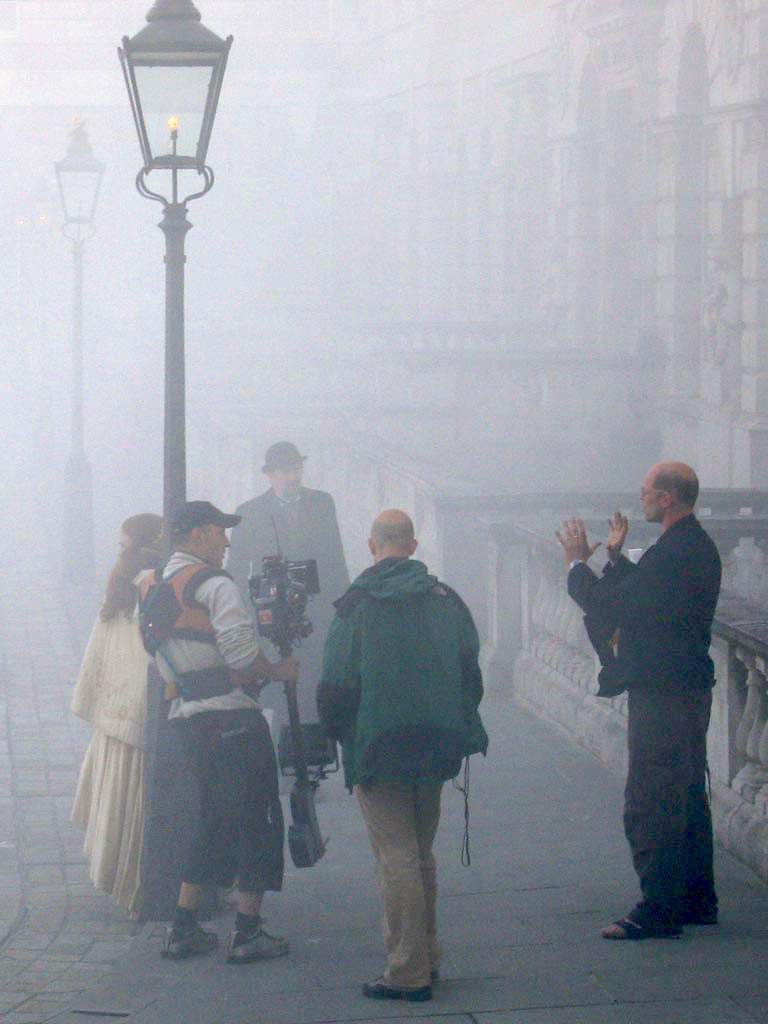
The Inky Fool made his own cinema version

Thursday, 3 April 2014

I Rare To Go


The other day, I was writing a text message in which I said that I was raring to go; and it struck me that rare is one of those odd verbs that you only see as a participle. Nobody ever says "I have rared to go", or "I plan to rare a lot on Thursday". It struck me that maybe you couldn't rare; maybe rare wasn't even a verb at all, as with sidling.

But it turns out that you can rare, and indeed often do. You just spell it slightly differently. Rare is a variant pronunciation of rear. Rear is an Old English word meaning raise (indeed if you go back even further in time rear and raise come from the same root). So you can rear a child, for example, without it being rude, or having anything to do with the rear end (which comes from the French).

Moreover, a horse can rear up on its hind legs. Horses do not do this simply in order to get things down from high shelves, they do it because they are impatient to get somewhere. They are rearing to go, or much more commonly raring to go.

Indeed, the first recorded use of the phrase in the OED has a significant apostrophe. It's from a book called Cabin Fever from 1918

‘Yuh ready?’ Foster's voice hissed in Bud's ear. ‘R'aring to go.

Of course, horses only rear children when they are in a stable relationship.

The first of the Inky Fool's equine kan-kan group was in training

Tuesday, 18 March 2014

Adults and Adultery


You don't have to commit adultery to be an adult, but you do need to have been an adolescent.

I was rather surprised to find that the words adult and adultery have nothing to do with each other, apart from the prefix ad-, which hardly counts.

Adultery comes from the Latin ad-altarare, where the second half is where we got the English word alter. Originally, it just meant that something had been changed and therefore falsified. From that you got the idea of corruption, to which was added (by the French) the notion of corrupting the marriage bed. Mind you, it's important to remember that the marriage bed can be corrupted by husband and wife having sex simply because they enjoy it. This is a sin. Even Chaucer says so in the Parson's Tale.

The thridde spece of Auowtrie is som tyme bitwixe a man and his wyf..whan they take no reward in hire assemblynge but oonly to hire flesshly delit.

I am confident that none of the readers of this pure blog would ever be so evil as to make sex enjoyable for themselves or others.

Meanwhile, there was another Latin verb alescere, which meant to be nourished. By putting an ad- on the beginning you got adolescere, which meant to grow up, and that meant that somebody in the process of growing up was adolescent. The past participle of the verb was adultus, which just means having grown up.

You can also, according to the OED, commit adultery by being a bishop when you shouldn't be. This means that I now have plans for this afternoon.

The Inky Fool gives in to temptation

P.S. There's a very kind review of The Horologicon here.

Friday, 14 February 2014

Valentines Again


Just a little repost today of this video of me explaining why Geoffrey Chaucer is responsible for your restaurant bill this evening.

And I should mention that I'm terribly grateful to Macmillan who have nominated Inky Fool in their Love English blog awards. You can vote on the subject until midnight tonight.


Monday, 3 February 2014

Less Fewers


Really?
I have been asked to pronounce on the explosive question of 10 Items or Less vs 10 Items or Fewer.

Just in case anyone is unaware of this Great Issue of the Day, there is a rule that appears in every English style guide: less amount and fewer numbers. So if I drink fewer pints, I have drunk less beer. That's because pints are something you can count, whereas beer is just frothy liquid.

Fewer children are less trouble.

I have less hair, because I have fewer hairs.

I have less shopping because I bought fewer items; fewer, in fact, than ten.

That's the rule. But, as with most rules, it's worth checking whether it's correct. After all, all that you need to get a book out on the English language is a willing publisher and a high opinion of yourself. I am living proof.

So, first let's check if you can use fewer for amount.

I like him fewer.

I am fewer happy today than yesterday.

I am fewer tall than you.

These are just plain wrong. And importantly they're not wrong because a style guide says so. They just Sound Wrong to A Native Speaker (SWANS). If a foreign friend were to talk like that you would giggle or gently correct them. This is not some rule known only to an elite few. It's SWANS, and SWANS is the most important rule of all.

So, what happens if you use less for numbers? Can you get the same effect?

I've drunk less pints than you.

There are less than five children here.

The answer must be less than five.

10 items or less.

Now, the thing about these is that though I know that the style guide tells me they're wrong, they aren't wrong in a SWANS way. They don't make you jump out of your skin. You would never be so rude as to correct a foreigner on this. The style guide says it's wrong, but it doesn't feel wrong.

I spent an awful lot of time trying to think of an example that sounded Properly Wrong, and I couldn't. I retreated into the desert and meditated on the subject* and I just couldn't think of anything that really sounded bad.

And then something really strange happened.

That's one fewer mouth to feed.

Sounds wrong. Properly SWANS wrong.

If we go this route, the journey will be twenty minutes fewer.

That's SWANS.

I have a hundred pounds. He has fewer.

That grates.

I started to find loads of examples where fewer sounded wrong when applied to a number, and less sounded right. I became confused and frightened and decided to try a different tack.

After style guides and SWANS, you can use God And Shakespeare (GAS) to decide what's correct. So I looked up fewer in the Shakespeare concordance.

He used the word 3 times. 3 times in 39 plays. That's really odd. That's less than he used also. The word only appears in Henry IV 2 once and Henry V twice. That's it. However, it is always applied to number.

Less, on the other hand, appears 225 times. And... and... I barely know how to tell you this:

Thou, why, thou wilt quarrel with a man that hath a hair more or a hair less in his beard than thou.

Shakespeare happily applies less to number as well as amount. Strange things are afoot at the Circle K.

So after a strong drink and a lie-down, I decided to proceed to the King James Bible. There, at least, I would find the eternal certainties on which I need to rely.

The KJV uses less 30 times. And it uses fewer once. Here's the line:

And ye shall divide the land by lot for an inheritance among your families: and to the more ye shall give the more inheritance, and to the fewer ye shall give the less inheritance: every man's inheritance shall be in the place where his lot falleth; according to the tribes of your fathers ye shall inherit. Numbers 33v54

That's it. God uses fewer even fewer times than Shakespeare.

So, where are we? Common usage, Shakespeare and God all seem to work the same way and have the same rule hanging around in the background. You can't use fewer for amount. But you can use less for number if you feel like it. And you can get away with not using fewer at all.

I realise that this is a surprising conclusion and that governments may fall, riots break out in the deserts and the earth fall from its orbit into the sun. But I couldn't care fewer. I hereby pronounce ex cathedra linguae anglorum that "10 Items or Less" is Absolutely Fine.

And for those of you interested either in the philosophy of mathematics or the works of Brett Easton Ellis, consider this: Fewer than Zero.


*Seriously. I was in a car that broke down somewhere near Abu Dhabi, and there wasn't much else to do.

Wednesday, 1 January 2014

Sherlock Holmes and Modernism


I do love pretending that this blog is topical, sprinting at the avant garde of the cutting edge, and as there's a new series of the new Sherlock Holmes starting tonight, I thought I'd write about the original Sherlock Holmes and how he relates to Modernism.

The Modernists were a bunch of different artists and thinkers and the like in the very late 19th and first half of the 20th Century. One of their Big Ideas was that the city was fragmented, which is a much simpler notion than it sounds.

The idea was that back at the beginning of the C19th almost everybody had lived simple rural lives in simple rural villages - the sort of place where everybody knows everybody. If you ever do see a stranger walking through town, you're bound to find out who he is by the end of the day because everybody will talk about him. If you hear a scream in the middle of the night, you can wake up the next morning and ask people what happened. If you see a hat lying at the side of the road, you pick it up and find out who it belongs to.

But then, over the course of the C19th, almost everybody moved to the city, and the city did their heads in. In the city you would see strangers all the time, nothing but strangers. And you would never find out where they had come from, or where they were going. You would be woken by a scream from the next street, but you would never find out who was screaming or what about. You would see people fighting down the alleyway, and you didn't know them, you didn't know what they were fighting about, you didn't stop to find out who won. You would see a hat lying on the pavement and you would never know to whom it belonged.

All you had in the city was fragments. The Modern world was, as T.S. Eliot put it, a heap of broken images. You got a paragraph of a story, but you never learned the beginning or the end. The Modernists decided that this was the Big Change in the way people lived their lives: specifically they thought that the human mind couldn't cope with it.

This idea is all over Modernist novels - the unknown strangers at the funeral in Ulysses, or passing Von Aschenbach on the street, or wandering through the Waste Land. Indeed, the Waste Land opens with meaningless fragments from some trip to the Hoffgarten. I shan't go on about this. If you're interested, I heartily recommend Christopher Butler's Early Modernism.

The point about all this is Sherlock Holmes.

To Sherlock Holmes, there are no fragments. To Sherlock Holmes, there are no strangers. The signature action of Sherlock Holmes is his ability to tell a visitor his whole biography after a mere glance, as he does at the opening of almost every tale. All stories are completed for him. There are no more fragments.

This is why we remember Sherlock Holmes much more than we remember any particular crime that he solves. Sherlock Holmes is a vision of how modern man can cope with the modern city. He is an idea and an ideal. Through Sherlock Holmes the Modern Condition of fragments and incomplete stories is vanquished. He is another way of looking at the city.

Sherlock Holmes is not a crime-solver, that is incidental. He is an idea. He is the Messiah who can save us all from Modernism.

Now whether that's actually possible is beside the point, just as it's beside the point to wonder whether the rural idylls of the early C19th ever really existed like that. The point is the idea. The point is that if Leopold Bloom or Eliot had had Sherlock by their sides there would have been no Ulysses and no Waste Land, just a comprehensible, coherent and complete world. There would have been no Modernism.

And for those of you poor souls who have never read the original stories, here is how Sherlock Holmes reacts to a hat left on the pavement. It's from The Adventure of the Blue Carbuncle.

"Then, what clue could you have as to his identity?"

"Only as much as we can deduce."

"From his hat?"

"Precisely."

"But you are joking. What can you gather from this old battered felt?"

"Here is my lens. You know my methods. What can you gather yourself as to the individuality of the man who has worn this article?"

I took the tattered object in my hands and turned it over rather ruefully. It was a very ordinary black hat of the usual round shape, hard and much the worse for wear. The lining had been of red silk, but was a good deal discoloured. There was no maker's name; but, as Holmes had remarked, the initials "H. B." were scrawled upon one side. It was pierced in the brim for a hat- securer, but the elastic was missing. For the rest, it was cracked, exceedingly dusty, and spotted in several places, although there seemed to have been some attempt to hide the discoloured patches by smearing them with ink.

"I can see nothing," said I, handing it back to my friend.

"On the contrary, Watson, you can see everything. You fail, however, to reason from what you see. You are too timid in drawing your inferences."

"Then, pray tell me what it is that you can infer from this hat?"
 
He picked it up and gazed at it in the peculiar introspective fashion which was characteristic of him. "It is perhaps less suggestive than it might have been," he remarked, "and yet there are a few inferences which are very distinct, and a few others which represent at least a strong balance of probability. That the man was highly intellectual is of course obvious upon the face of it, and also that he was fairly well-to-do within the last three years, although he has now fallen upon evil days. He had foresight, but has less now than formerly, pointing to a moral retrogression, which, when taken with the decline of his fortunes, seems to indicate some evil influence, probably drink, at work upon him. This may account also for the obvious fact that his wife has ceased to love him."
"My dear Holmes!"

"He has, however, retained some degree of self-respect," he continued, disregarding my remonstrance. "He is a man who leads a sedentary life, goes out little, is out of training entirely, is middle-aged, has grizzled hair which he has had cut within the last few days, and which he anoints with lime-cream. These are the more patent facts which are to be deduced from his hat. Also, by the way, that it is extremely improbable that he has gas laid on in his house."

"You are certainly joking, Holmes."

"Not in the least. Is it possible that even now, when I give you these results, you are unable to see how they are attained?"

"I have no doubt that I am very stupid, but I must confess that I am unable to follow you. For example, how did you deduce that this man was intellectual?"
 
For answer Holmes clapped the hat upon his head. It came right over the forehead and settled upon the bridge of his nose. "It is a question of cubic capacity," said he; "a man with so large a brain must have something in it."

"The decline of his fortunes, then?"
 
"This hat is three years old. These flat brims curled at the edge came in then. It is a hat of the very best quality. Look at the band of ribbed silk and the excellent lining. If this man could afford to buy so expensive a hat three years ago, and has had no hat since, then he has assuredly gone down in the world."

"Well, that is clear enough, certainly. But how about the foresight and the moral retrogression?"
Sherlock Holmes laughed. "Here is the foresight," said he putting his finger upon the little disc and loop of the hat-securer. "They are never sold upon hats. If this man ordered one, it is a sign of a certain amount of foresight, since he went out of his way to take this precaution against the wind. But since we see that he has broken the elastic and has not troubled to replace it, it is obvious that he has less foresight now than formerly, which is a distinct proof of a weakening nature. On the other hand, he has endeavoured to conceal some of these stains upon the felt by daubing them with ink, which is a sign that he has not entirely lost his self-respect."

"Your reasoning is certainly plausible."

"The further points, that he is middle-aged, that his hair is grizzled, that it has been recently cut, and that he uses lime-cream, are all to be gathered from a close examination of the lower part of the lining. The lens discloses a large number of hair ends, clean cut by the scissors of the barber. They all appear to be adhesive, and there is a distinct odour of lime-cream. This dust, you will observe, is not the gritty, gray dust of the street but the fluffy brown dust of the house, showing that it has been hung up indoors most of the time, while the marks of moisture upon the inside are proof positive that the wearer perspired very freely, and could therefore, hardly be in the best of training."
 
"But his wife -- you said that she had ceased to love him."

"This hat has not been brushed for weeks. When I see you, my dear Watson, with a week's accumulation of dust upon your hat, and when your wife allows you to go out in such a state, I shall fear that you also have been unfortunate enough to lose your wife's affection."
 
"But he might be a bachelor."

"Nay, he was bringing home the goose as a peace-offering to his wife. Remember the card upon the bird's leg."

"You have an answer to everything. But how on earth do you deduce that the gas is not laid on in his house?"

"One tallow stain, or even two, might come by chance; but when I see no less than five, I think that there can be little doubt that the individual must be brought into frequent contact with burning tallow -- walks upstairs at night probably with his hat in one hand and a guttering candle in the other. Anyhow, he never got tallow-stains from a gasjet. Are you satisfied?"